
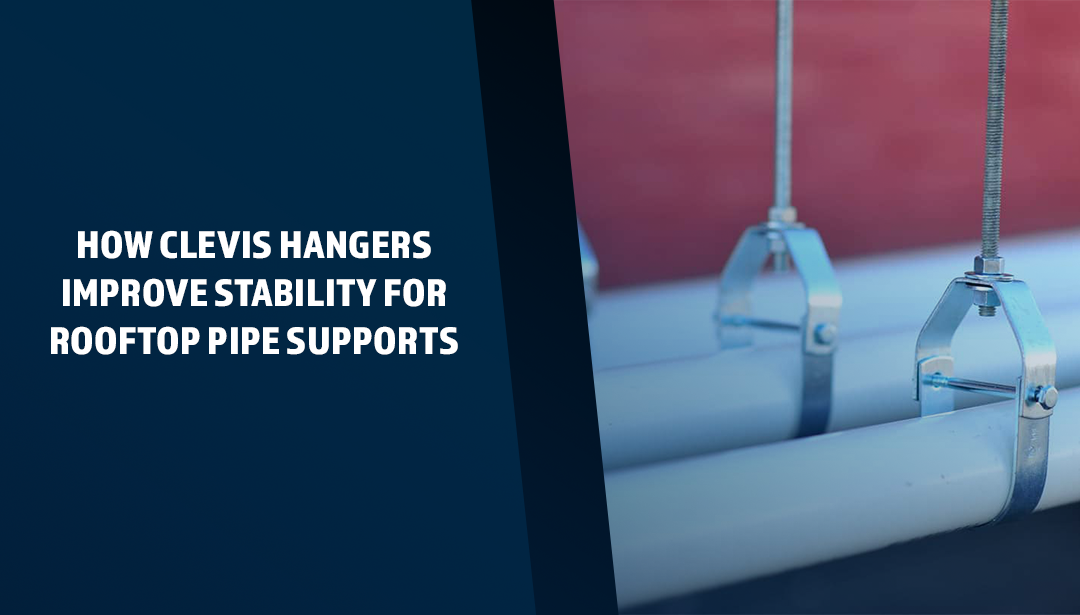
Pipes installed on commercial rooftops need consistent support to prevent sagging, shifting, and unnecessary stress on pipe connections. When a support system does not maintain the required elevation or accommodate movement, the piping can place additional loads on its connections and surrounding equipment. Improperly supported lines can also create problems for the rooftop assembly, particularly when support locations, spacing, and loading have not been properly coordinated.
Clevis hangers provide a common solution for supporting vertical pipe loads while allowing height adjustments during installation. Their open, U-shaped design holds the pipe in position without fully enclosing it, and certain designs allow limited movement to make pipe installation easier. Contractors use clevis hangers in HVAC and other mechanical piping applications where the pipe requires consistent support and the installation calls for an adjustable connection. Understanding how clevis hangers work, how different designs accommodate specific piping materials, and when to choose a pipe roller can help project teams specify the appropriate rooftop support assembly.
What Are Clevis Hangers and How Do They Work?

A clevis hanger is a pipe attachment designed to suspend and support stationary piping. A typical assembly consists of an upper clevis or yoke connected to a threaded hanger rod and a formed steel bottom strap that supports the pipe. A cross bolt or clevis pin secures the lower strap to the hanger assembly. The threaded rod connects the hanger to the supporting structure, allowing installers to adjust the pipe’s vertical position during installation.
The lower U-shaped strap supports the pipe from beneath, distributing its weight across the contact area of the hanger. The upper connection transfers that load to the threaded rod and supporting structure. Depending on the hanger design, installers can make vertical adjustments without removing the pipe. This is useful when establishing pipe elevation, maintaining clearance from other rooftop components, or coordinating several lines within a mechanical installation. Clevis hangers can support insulated and non-insulated piping, although insulated lines may require a pipe saddle or other insulation protection to prevent the hanger from compressing the insulation.
Some clevis hanger designs include features that make pipe installation easier by allowing limited movement during positioning. Certain configurations provide a 15-degree swing in either direction, giving installers additional clearance when feeding pipe through the hanger. Non-pinching designs also help prevent the lower strap from binding during installation. These features can reduce the difficulty of positioning piping overhead, although the available movement and adjustment range depend on the selected hanger design.
Why Use Clevis Hangers for Rooftop Pipe Support?

Clevis hangers are commonly specified for rooftop HVAC piping because they provide direct vertical support and allow installers to make adjustments during assembly. Rooftop piping often needs to maintain a defined elevation to preserve clearance from the roof surface, accommodate insulation, and coordinate with other mechanical equipment. An adjustable hanger makes it easier to establish the required pipe height without removing the line from the support assembly. This can be particularly useful when contractors are working with multiple piping runs or connecting new lines to existing rooftop systems.
The open design also makes clevis hangers practical for field installation. Contractors can position the pipe within the lower strap, secure the cross bolt, and adjust the hanger rod as needed. This straightforward arrangement works well for stationary piping where vertical support is the primary requirement. Clevis hangers are available in different sizes, finishes, and configurations, allowing project teams to select a hanger based on pipe diameter, material, insulation requirements, and environmental conditions.
On a rooftop, however, the clevis hanger is only one component of the complete support assembly. The hanger must connect to a properly designed frame or support structure that transfers the piping load to the roof through an appropriate base configuration. The full assembly must account for pipe weight, support spacing, roof conditions, and applicable project requirements. Rooftop Support Systems specifies clevis hangers as an option for uninsulated piping within its rooftop support systems. For insulated piping, the company’s specifications identify a band hanger supported from horizontal channel or a clevis hanger with a pipe saddle. This distinction helps ensure that the selected hanger accommodates the actual piping configuration rather than treating all pipe installations the same way.
Cost is another reason contractors frequently select clevis hangers. Their relatively simple construction and broad availability make them a practical option for many stationary piping applications. They provide vertical adjustment without requiring a more specialized movement mechanism, which can help control component costs when the piping does not require longitudinal travel. The appropriate selection still depends on the pipe load, hanger rating, rod size, and supporting frame design. A lower component price should never replace verification of the complete assembly’s load requirements.
Types of Clevis Hangers for Different Applications

Clevis hangers are available in several configurations to accommodate different pipe materials and operating conditions. Standard steel clevis hangers are commonly used for stationary piping where the pipe material and hanger contact surfaces are compatible. Plastic-coated clevis hangers provide a protective layer between the hanger and the pipe. This coating can help reduce direct metal-to-metal contact and limit noise and vibration transmission through the support. These hangers are commonly available for steel pipe and other compatible pipe materials. The coating and hanger dimensions should be checked against the manufacturer’s specifications to confirm compatibility with the piping material and outside diameter.
Felt-lined clevis hangers are another option, particularly for copper tubing. The felt lining separates the copper tube from the steel hanger, helping reduce the potential for electrolysis between dissimilar metals at the contact point. The lining can also help reduce noise and vibration within the piping system. Selecting the appropriate hanger lining is important because pipe material, outside diameter, and operating conditions all affect compatibility.
Light-duty and standard-duty configurations also serve different applications. Light-duty clevis hangers are intended for lighter stationary piping, while heavier-duty options are available for larger pipe sizes and higher support loads. Selection should be based on the actual weight of the pipe, fluid contents, insulation, and any additional loads included in the design. Contractors and engineers should verify the manufacturer’s published load ratings, rod requirements, and dimensional information rather than assuming that a larger-looking hanger automatically provides sufficient capacity. The hanger, threaded rod, fasteners, and supporting frame must all be suitable for the design load.
Finish selection also affects how a clevis hanger performs in its installed environment. Common finishes include electro-galvanized and hot-dip galvanized steel. Electro-galvanized finishes provide a zinc coating for corrosion protection, while hot-dip galvanizing applies a thicker zinc coating after fabrication. Hot-dip galvanized components are often specified for rooftop installations where exposure to moisture and changing weather conditions makes corrosion resistance a consideration. Other coatings and finishes may be available depending on the manufacturer and product series. Project specifications should identify the required finish and ensure that connected hardware is compatible with the selected support materials.
Clevis Hanger vs. Pipe Roller: Which Is Better for Rooftops?

Clevis hangers and pipe roller hangers both support piping, but they accommodate movement differently. A standard clevis hanger supports the pipe within a formed metal strap and is generally recommended for stationary piping. It provides vertical support and adjustment, but it does not provide the same controlled longitudinal movement as a roller assembly. When a pipe experiences significant thermal expansion and contraction, restricting that movement can transfer additional stress to pipe connections, anchors, and support components.
A pipe roller hanger adds a roller mechanism that allows the pipe to move horizontally along the support as temperatures change. The hanger supports the pipe while permitting longitudinal travel, reducing the need for the pipe to slide directly against a fixed metal support. In a typical roller arrangement, the hanger yoke connects to a roller rod or assembly rather than relying on the same fixed lower strap configuration found in a standard clevis hanger. The amount of movement available depends on the roller design, pipe configuration, and installation details.
The choice between a clevis hanger and a pipe roller should begin with the expected movement of the piping system. Clevis hangers are appropriate when the pipe is stationary and vertical support is the primary requirement. They are often used for smaller or shorter piping runs where the system design does not require a dedicated rolling mechanism. Pipe rollers are better suited to applications where thermal expansion and contraction create a need for longitudinal movement. Longer pipe runs and systems operating through wider temperature changes may require additional consideration of movement, guides, anchors, and expansion provisions.
Neither hanger type should be treated as a complete wind or seismic restraint by itself. A roller provides a movement allowance, while a standard clevis hanger provides vertical support. Neither function automatically addresses the lateral forces that can affect rooftop piping during high winds or seismic events. Those requirements must be evaluated as part of the complete engineered support assembly. Rooftop Support Systems offers configurations for high-wind and seismic applications, but the appropriate assembly depends on project-specific design requirements. Engineers should verify the applicable drawings, calculations, and restraint details rather than assuming that changing the hanger type alone satisfies those requirements.
Reducing Vibration and Noise in Rooftop Systems
Mechanical piping can transmit vibration from pumps, compressors, HVAC equipment, and other operating machinery into the support structure. When a pipe rests directly against a metal hanger, vibration can transfer through the contact surfaces and contribute to noise within the building. Repeated vibration can also place additional stress on pipe connections and nearby components. Selecting a hanger with an appropriate contact surface can help limit some of this transmission.
Plastic-coated clevis hangers provide a layer between the pipe and the steel hanger. This reduces direct metal-to-metal contact and can help limit noise and vibration in compatible piping systems. Felt-lined clevis hangers serve a similar purpose while also addressing material compatibility for copper tubing. The felt lining helps separate copper from the steel hanger, reducing the potential for electrolysis at the contact point. These designs are particularly relevant when piping runs serve occupied buildings, residential properties, offices, healthcare facilities, or other locations where mechanical noise can affect building occupants.
The hanger lining is only one part of vibration control. Equipment isolation, flexible connectors, pipe guides, anchors, and the overall support arrangement can all affect how vibration travels through a mechanical system. A plastic-coated or felt-lined hanger should not be treated as a substitute for engineered vibration isolation where equipment or piping specifications require it. Project teams should review equipment requirements and mechanical drawings to determine whether additional isolation components are necessary.
Proper installation also affects hanger performance. The pipe must sit correctly within the lower strap, and the cross bolt and hanger rod connections must be secured according to the manufacturer’s instructions. Installers should avoid using an oversized hanger without the required spacer or other manufacturer-specified hardware. For example, Eaton advises using a pipe spacer over the cross bolt when an oversized clevis is used to prevent the lower U-strap from moving inward. Following these installation details helps maintain the intended contact and load arrangement throughout the piping system.
Clevis Hanger Solutions for Rooftop Pipe Support
At Rooftop Support Systems, we offer pipe support components designed to meet the demands of commercial and industrial rooftop installations. Our clevis hanger options include hot-dip galvanized steel configurations in sizes ranging from 1/2 inch to 24 inches, providing contractors with options for a wide range of stationary piping applications. For systems that require longitudinal movement, we also offer pipe roller supports that accommodate thermal expansion and contraction. By offering different support configurations, we help contractors and project teams select components that correspond to their piping requirements.
Selecting the right rooftop pipe support involves evaluating pipe size, material, insulation, loading, and expected movement. Our team understands how these factors influence support selection and can help identify suitable configurations for individual projects. Whether your installation calls for standard clevis hangers, roller supports, or additional rooftop support components, RTS is ready to help. Contact our team to discuss your project requirements or explore our full range of rooftop pipe support products.


